


:quality(75))
:quality(75))
How can I enable people to work more effectively? TIAS professor of Strategic Leadership Ron Meyer presents an insightful tool to kickstart your thinking: Humanistic Organization.
Key Definitions
Organizations are groups of people working together to achieve a shared goal. To realize their common objective, they split the required tasks amongst one another and then cooperate to align their activities. This division and subsequent coordination of labor makes specialization possible, leading to increased expertise (higher quality) and economies-of-scale (lower cost).
There are many types of organizations, but a more limited number of organizational paradigms – lenses through which we understand what organizations are and how they function. For centuries, the most dominant paradigm has been to see organizations as a type of machine, with people as human resources slotted into the machine (mechanistic organization paradigm).
Conceptual Model
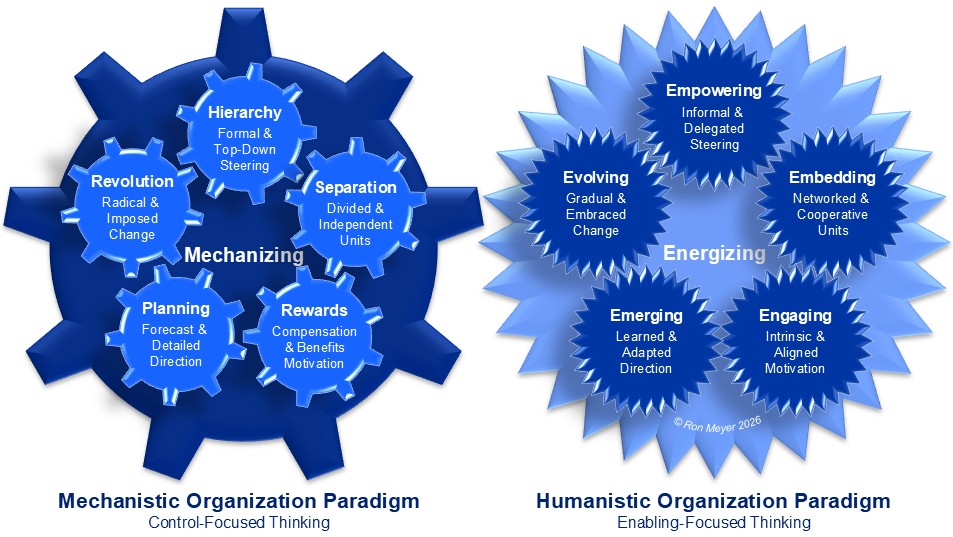
The Humanistic Organization Paradigm is a cognitive framework for understanding what organizations are and how they function. To clarify its fundamental tenets, the figure below contrasts the humanistic perspective with the core assumptions underpinning the mechanistic organization paradigm. While the latter sees people as human resources that can be employed to enable the machine to work more effectively, the humanistic organization paradigm sees organizations as arrangements that enable people to work more effectively. The mechanistic approach is focused on controlling everything, including people, while the humanistic approach aims at enabling people. Using this paradigm more consistently can have a far-reaching impact on how people organize, while as a practical tool it can be used as checklist to search for ways to energize people and improve organizational effectiveness.
Key Elements
The five main differences between the paradigms are the following:
1. From Hierarchy to Empowering. Instead of using a formalized power structure to steer the organization top-down, the humanistic paradigm emphasizes more ownership, responsibility and decision-making in the hands of the doers, guided by leaders nudging people in the right direction using their informal authority. This results in organizations that are flatter, with managers who do not control and coerce, but facilitate and encourage.
2. From Separation to Embedding. Instead of splitting tasks and then keeping them in independent silos (all division and little coordination of labor), the humanistic paradigm emphasizes coordinative networking between individuals, teams, units and even organizations, with the intention to cooperate and link up. This results in organizations that are collaborative ecosystems, with people preferring long-term over transactional relations.
3. From Rewards to Engaging. Instead of using compensation and benefits to motivate people to perform, the humanistic paradigm emphasizes triggering people’s intrinsic motivation, by appealing to their need for purpose, meaning, direction, contribution, community and safety. This results in organizations with high team spirit, with people who have committed their hearts and minds, instead of only responding to carrots and sticks.
4. From Planning to Emerging. Instead of predicting the future and drawing up a detailed roadmap of how to get there, the humanistic paradigm emphasizes the need to embrace volatility, uncertainty, complexity and ambiguity, by getting people to guestimate, try, reflect and course correct. This results in organizations that are resilient and agile, that is, robust and able to flexibly respond to unfolding circumstances, instead of fragile and rigid.
5. From Revolution to Evolving. Instead of pushing through large and widespread changes within a short time span on to reluctant people, the humanistic paradigm emphasizes the need to gradually and continuously change, giving people time to let go, embrace, learn and adjust, with leaders as sherpas guiding people on their adventure. This results in organizations that are adaptive, with change not being done to people, but with people.
Key Insights
• The humanistic organization paradigm is a lens. Paradigms are cognitive filters through which we view the world. They are not true or false, but color our understanding of reality. The mechanistic organization paradigm has been around for centuries, even before it became mainstream starting with Taylor in the early twentieth century. But more human-focused thinking is also not new, going back to Mayo in the 1930s (human relations theory).
• The humanistic organization paradigm is human-centric. While the mechanistic paradigm sees organizations as a type of machine running on human resources, the humanistic paradigm sees organizations as collections of humans working together in particular ways – people don’t work at an organization, they are the organization.
• The humanistic organization paradigm emphasizes enabling. Machine-thinking is about controlling – determining the future and what people do. It is based on the power to predict and command, while the compliance of people must be forced or bought. Human-centered thinking is about enabling – facilitating people to take responsibility and act. It is based on the informal power to nudge and guide, while people’s commitment must be won.
• The humanistic organization paradigm has five distinctive characteristics. People can be enabled and energized by empowering them, embedding them, and engaging them, while also involving them in the emerging direction and the evolving organization.
• The humanistic organization paradigm can also be used as a checklist. While this paradigm can be adopted as organizational philosophy, it can also be used as an inspirational checklist to consider different ways of getting people to work more effectively.